


IN SHORT
3rd generation
Compact sedan
Appearance of plug-in hybrid versions
From 24,800 €
The second generation of the 308 marked the start of Peugeot’s upscaling. A strategy that has been crowned with success since the compact lion has been a commercial success since its debut in 2013. Thus, it was for many years and until the end of 2020 the best-selling compact sedan in France with a regular seat in the top 10 sales and is one of the favorite Peugeot of the French with the 208 and 3008. It is therefore ahead of most of its rivals such as the Volkswagen Golf or even some premium competitors such as the Mercedes Class A or BMW 1 Series.

Video test – Peugeot 308 (2021): stop or still?
Arrived at the top, the 308 must now stay there and that is the hardest part. To take up this challenge, Peugeot has chosen, as has been the case for several years now, to start from scratch and take as much risk as possible, and this requires above all a completely new design.

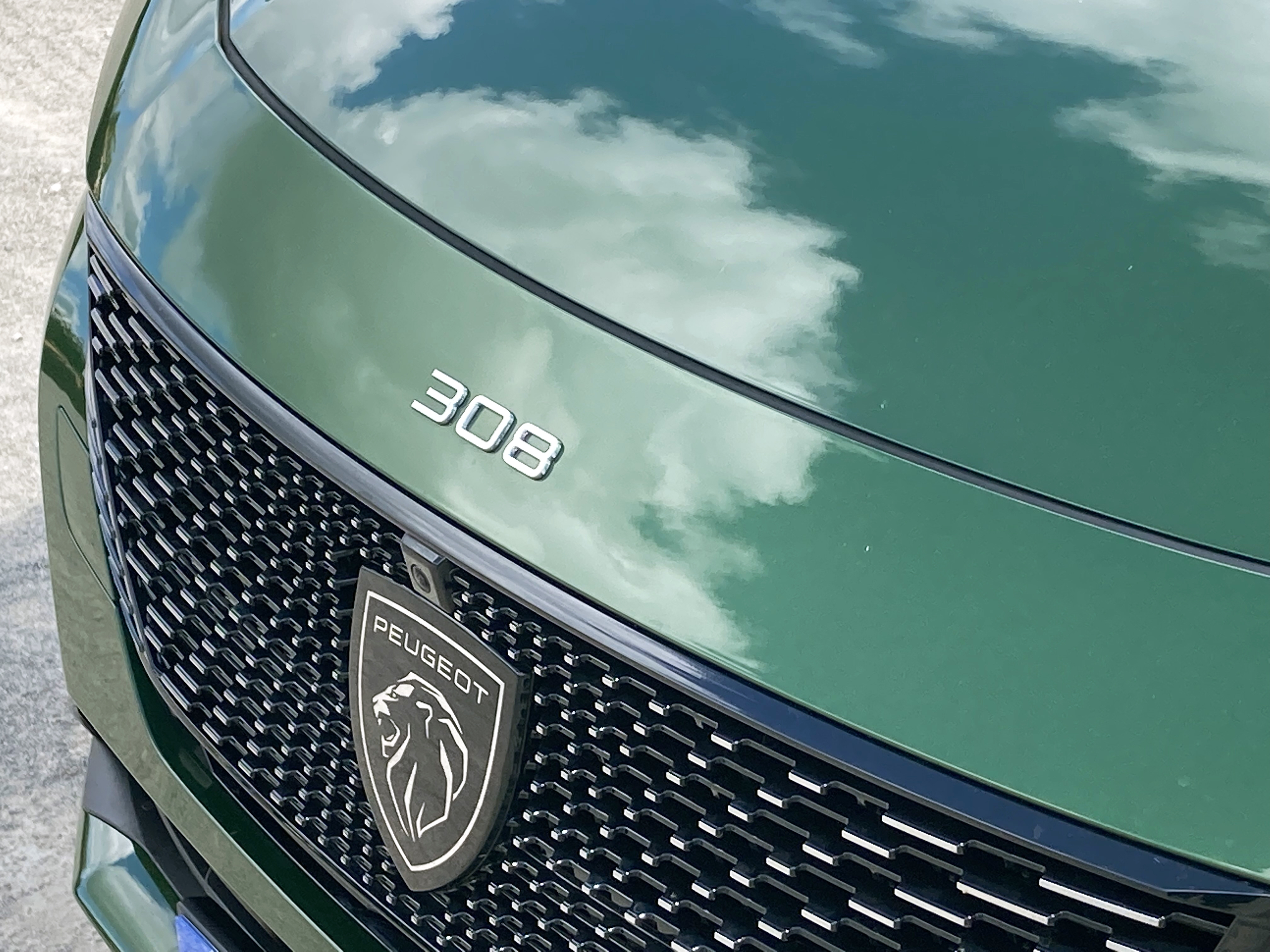

The first thing you notice immediately is the particularly expressive front end. Lower than previously, it consists in particular of a grille which has been enlarged and which accommodates for the first time the new Peugeot logo which now takes the form of a coat of arms. It is positioned in the center of the very large grille, the patterns of which give the impression of converging towards it. It is surrounded by very thin projectors which are Full LED series but can accommodate Matrix LED technology and of course by vertical daytime running lights like many models of the Sochaux manufacturer.

The rear also receives its share of modifications with lights – also very thin – which take the characteristic claws of Peugeot – connected by a black band.

The other big part of the engineers’ work focused on changing the proportions of this 308. The goal is clearly to overshadow the German sedans. The French compact takes up the codes, notably with a hood that has been lengthened. This involves a windshield that has been moved back 10 cm and the addition of a soft nose (plastic piece located between the hood and the grille) 90 mm long as is already the case on the 508 But that’s not all, since the front and rear overhangs have been enlarged and the same is true of the wheelbase, which has gained 55 mm (2,675 mm). The width remains the same but the height decreases by 20 mm. In the end, the 308 now measures 4.36 m long, 1.80 m wide and 1.44 m high. It moves away from the Volkswagen Golf but is closer to the Mercedes Class A and BMW Series 1.

This new look is accompanied by substantial work on the body sculpture on the front and rear fenders, but also on the bonnet which is crossed by body lines that are not straight but rounded. It is also impossible not to notice the resumption of the famous logo on the front fenders – for the high finishes only – as a certain brand with the prancing horse.
An interior presentation always so different

For several models, Peugeot has stood out from the competition by adopting an atypical dashboard organization called “i-cockpit”. This has evolved over the years but it still consists of a small steering wheel, high instrumentation and a multimedia screen oriented towards the driver. The 308 is no exception and inherits some new features such as digital instrumentation now 3D like the 208 and 2008 or the multimedia screen which now reaches 10 inches.


But, however, beyond the dimensions, we will especially remember that it benefits from a new operating system which makes it much more efficient, fluid and pleasant to use. A huge difference compared to the old one which shows a beautiful slowness. The progress is more than significant. This screen overlooks five fully customizable numeric keys that act as shortcuts to certain functions (air conditioning temperature, preferred radio, etc.). Six classic commands are also present. They provide access to certain functions of the car, defrosting, air conditioning or hazard warning lights.
The very horizontal dashboard is more massive than on the older generation. The central console has also been redesigned with plenty of storage space which is very practical. As one would expect the quality of the materials is good even if some hard plastics are present at the level of the center console or the lower part of the dashboard.


Rear roominess and cargo volume are average for the segment.
Status quo or almost in terms of practical aspects The loading volume is now 412 liters against 420 liters previously. Plug-in hybrid versions will have to be content with 361 liters. The rear roominess remains in the average of the category, in particular for the space in the knees.


