


Those who have already resold their car on their own know that the necessary step of writing an ad, and organizing test drives with potential buyers are times that can already be quite stressful.
But even less than when the moment of payment arrives. We always have in the back of our mind the fear of letting our car go for a fraudulent payment, a wooden check, a fake cashier’s check, or counterfeit bills. And scams are indeed numerous, even if they only affect a very (very) small percentage of sales.
How then to secure the payment of your car? What are the means at your disposal to make sure you get your money back? You have to distinguish between advice, depending on the ways you get paid.
Cash payment
Contrary to popular belief, there is no “ceiling” amount for a payment in cash between individuals. This is only the case for a purchase from a professional (1000 € maximum).

But between individuals, it is mandatory, when the sum exceeds € 1,500, to establish a written document in duplicate, which is equivalent to “invoice” (bad term because one cannot establish an invoice between individuals), and which must mention the amount paid and the nature of the transaction, in this case the sale of a car.
But that is not enough to guarantee payment. It is also important to ensure that the tickets provided by your buyer are not fake.
How to secure this payment?
The only reliable solution is to have them checked in the presence of your buyer in a bank branch. A buyer who refuses it will have to immediately make you withdraw from the sale. The downside is that you have to carry out the transaction during bank branch opening hours.
Payment by cashier’s check

If you are formally advised against payment by simple check, which is far too risky, you can accept payment by cashier’s check. This type of check ensures that the buyer has the funds available, because it is guaranteed by the bank, which will have previously verified that his client’s account is sufficiently funded, and will have blocked the funds. The check is then issued by the bank itself.
But that does not prevent the cashier’s check scam (presentation of a stolen check or a false check).
How to secure this payment?
You need to verify the authenticity of the check. Ask your buyer to send you a photo or scan of the check before the transaction takes place.
Once you have this in hand, search the web for the contact details of the agency issuing the check. Do not call the number possibly present on the check, it could lead to an accomplice. The agency in question can then confirm that it is the issuer of the check, using its number. This information is in fact not subject to banking secrecy. With the cashier’s check in hand, also check that it is the same as the one sent by scan or photo (you may have been sent by scan or photo the image of a real one, obtained by making a fake sale, but come with a fake, resembling …).
If this is the case, then you can be reassured and let the buyer leave with the car.
Payment by bank transfer
Paying by wire transfer may seem secure, as it is only possible if the buyer’s account is funded. But the risk is real. Here’s the scenario: You provide the buyer with an RIB for payment for your car. He makes a transfer, which you see arriving in your account 2 to 3 days later. You let the buyer go with the car. However, a few days later, you realize that the transfer has been debited from your account. The reason: The issuing bank canceled the transfer because the buyer’s account had been funded by a fake check / wooden check / stolen check.

Variation: what you believed to be a wire transfer arrived in your account was in fact the deposit of a check in your account, carried out by the purchaser himself with a fake check / stolen check / wooden check, thanks to the information of your RIB. Once the checks are done by your bank, it cancels the deposit and debits the account.
You then find yourself without a car or money. It is very difficult to get out of this kind of situation. Indeed, even if a transfer is supposed to be irrevocable, the banks do not hesitate to cancel them, without even your consent, which is however supposed to be obligatory for this. It is then necessary to initiate lengthy procedures to prove your good faith, or even to go to court.
How to secure this payment?
In the end, the only way to secure a transfer is to wait at least 20 days before giving the keys to the buyer. After this period, the transfer becomes credited “for good”, which means that the source of the funds has been verified, there is no longer any risk of the transfer being canceled.
The buyer must therefore be (very) patient. And in reality, paying by cashier’s check is safer, as long as you can verify it.
NB: the risk is the same with an instant transfer as with a traditional transfer.
Payment via a trusted third party
There were several of them a few years ago (Depopass and Paycar, for the main ones). Today, only the Paycar player still exists, apart from solutions integrated with other more complete and expensive services.
And no matter what, it is the only solution that allows a payment to be completely secure. This requires that the two protagonists, buyer and seller, register on the platform. Their identity and bank details are verified within 24 hours.
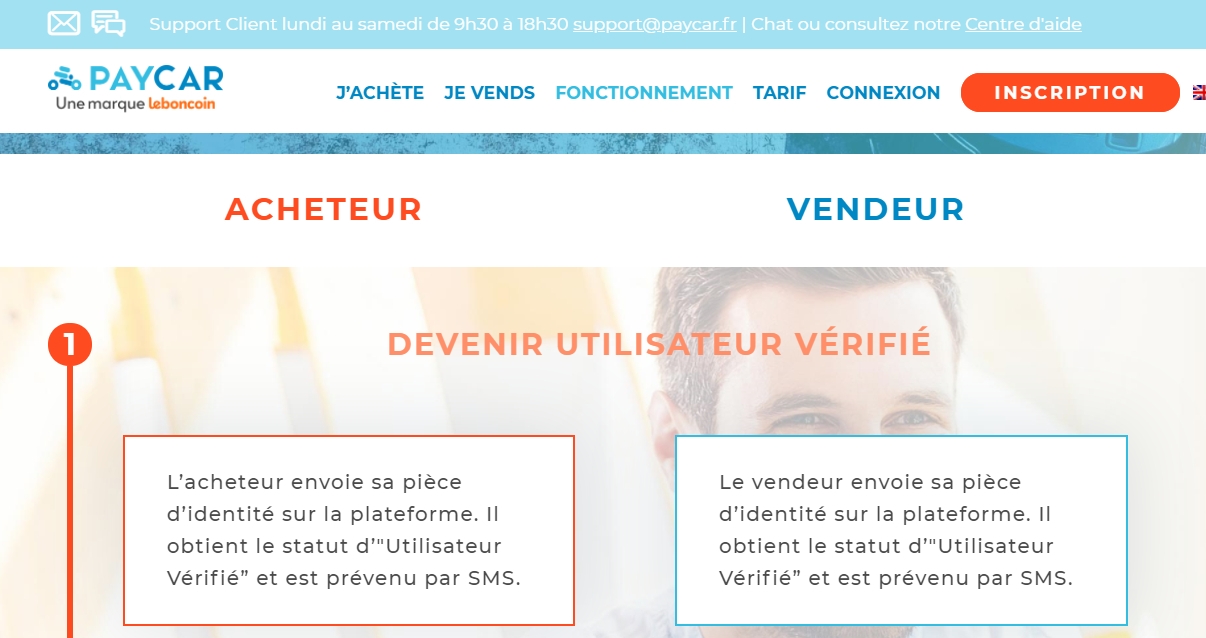
When the amount of the transaction is defined, the buyer makes a transfer to his electronic wallet in the application. The seller can then verify that the funds are present. When the buyer comes to pick up the car, the seller provides a code so that the buyer can send the funds, which are instantly transferred. The defined amount may be less than what the buyer has credited, in the event of additional negotiation in front of the car (the buyer can then recover the difference). This transfer is provided by Paycar as totally irrevocable. The seller can then in turn transfer the funds to their own bank account, minus a commission for Paycar of € 29.
As long as the transfer of funds is assured as completely irrevocable, this is the safest way to get paid for your opportunity. No risk of seeing the money go the other way.
The downside is that the service costs 29 € to the one who sells, while the cashier’s check, which is also the most frequently charged, costs the buyer money, not the seller.
NB: Paycar is the service used by leboncoin (which now owns this company) to secure transactions. A good thing, once is not a habit coming from the right corner.
THE BALANCE SHEET
With these elements in hand, we do not recommend accepting cash transactions if it is outside the opening period of bank branches. The cashier’s check is valid only if you have been able to ensure its validity in advance. This is the only way that costs the seller nothing. The alternative of Paycar, paying for the seller, is interesting because the security is high, and the cost, after all, quite low for a transaction of several thousand euros. We are far from the idea of advertising it, however, because it is a paying method.


