


Shortly before the presentation of its EQS, Mercedes invited L’argus aboard this new 100% electric limousine. To be frank, we were simply a virtual passenger, there will be no question here of feeling in terms of comfort and even less driving dynamism. So after unveiling the cockpit, it’s time to talk about the technical part. Unlike the EQA and EQC already marketed, this EQS uses a new platform that has nothing in common with the recent S-Class.
Mercedes EQS: rear-wheel drive or full

In this case, it is the new EVA2 modular platform which will also be used for the little sister, EQE, but also for the SUV derivatives of these two sedans. In addition to its variable dimensions, this platform, equipped with a 400 V architecture, can accommodate batteries of different capacities, but also one or two electromotors. In the case that interests us here, the EQS will be available, at launch, in two versions.
A first, under the name EQS 450+, will have a 90 kWh battery powering an electromotor placed on the rear axle. The power will then be 245 kW (333 hp) for a torque of 568 Nm. The second, EQS 580 4MATIC +, will have a battery with a capacity of 107.8 kWh which will supply its energy to two electric motors: one on each axle.. This version will develop a power of 385 kW (or 524 hp) for a torque of 855 Nm. In all cases, the electric machines are permanent magnet synchronous. As for the batteries, Mercedes announces that it will be possible to update their energy management remotely.
TO READ. Mercedes EQS (2021). Battery production started in Germany
A record Cx of 0.20!
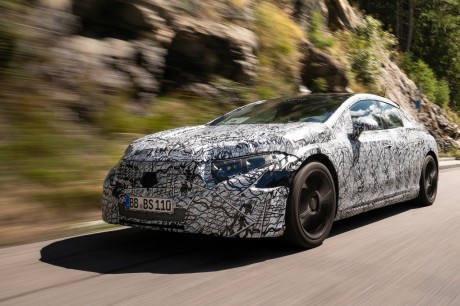
Top speed is limited, in both cases to 210 km / h, and the range of 770 km, according to the WLTP cycle, will depend on the model and the equipment chosen. To achieve this range, the EQS has an aerodynamic coefficient of 0.20. For comparison, the recent S-Class shows 0.22. The slender, coupé-like design has a lot to do with it, but in addition, the EQS has a complete fairing of its underpinnings, as well as aerodynamic elements of which the retractable door handles are also part. Energy recovery is managed via the paddles behind the steering wheel in three modes : it is thus possible to obtain a maximum recovery power of 290 kW (for the 4MATIC version) and to come to a complete stop without touching the brake pedal.
TO READ. Mercedes EQS (2021). Welcome aboard the electric limousine
Everything goes through the GPS
When the GPS is activated, the charging stations are indicated on the route which will be calculated according to the behavior adopted, the traffic, the outside temperature … And if the car needs to “refuel”, the system prepares the battery to reach the ideal temperature for recharging. Like at Tesla or Porsche… The EQS can also determine if the battery charge is sufficient for a round trip without plugging in. It is also possible to add terminals in the system: they will then be privileged. The cost of any charge is communicated before arriving at the terminal. And if this limit cannot be reached under normal conditions of use, the system will recommend switching to Eco mode.
EQS can recover up to 300 km in 15 min
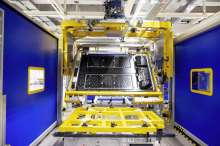
The EQS series charger allows connection to terminals providing up to 22 kW of alternating current. It is also possible to have a charger allowing connection to direct current that can provide up to 200 kW. Enough to recover 300 km in 15 minutes. If necessary, the vehicle can supply its electricity to the local network (only in Japan, at first).
.


