


Since 2020, no one has escaped it. From BMW to Volkswagen, from Stellantis to Renault-Nissan-Mitsubishi, each automotive group must drastically reduce its CO emissions2 to dodge the vertiginous fines distributed by Brussels. The rule also applies to Suzuki, forced to overhaul its range last year. Thus, each model now imposes micro-hybridization (S-Cross, Vitara, Ignis, Swift and even Swift Sport!), While the boor Jimny, who drags a greedy four-cylinder 100% thermal, is no longer sold than ‘in utility version to escape calculation. The ultimate lever of (de) growth consists in rebadgering models of compatriot Toyota, much more advanced in terms of classic and plug-in hybridization. At the end of 2020, therefore, two new “Suzuta” (or “Toyoki”?) Joined the range:
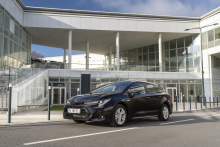
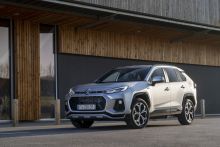
Thanks to a particularly favorable approval cycle, plug-in hybrid technology is the best in terms of CO emissions.2 : only 22 g / km for our Across, against 103 g / km minimum for the Swace hybrid and 121 g / km for the micro-hybrid Vitara. This system weighs heavily in the balance, however, very real first (1,940 kg announced empty), then tariff.
Suzuki Across 2021 bonus and prizes
At € 56,200 starting price, the Across becomes the most expensive production Suzuki in history. The bill is actually less salty thanks to a 1st Edition launch series at € 53,990 and, until June 30, 2021, an exceptional discount of € 4,000 which triggers the famous € 2,000 bonus (reserved for models plug-in hybrids billed for less than € 50,000). There is no risk of exceeding this fateful threshold by picking from the list of options, the latter being quite simply non-existent.
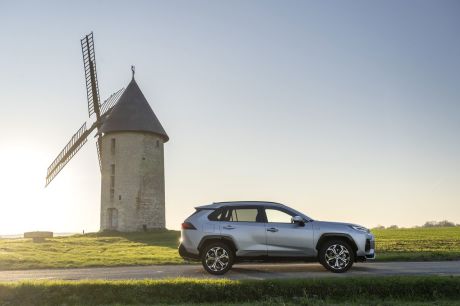
Metallic paint, 19 ”rims, heated front and rear seats, hands-free motorized tailgate, semi-autonomous driving system, everything is delivered as standard in Across. The only oversight? Integrated GPS navigation, easily replaced by equivalent smartphone apps (replicable on the 9 ”touchscreen via Android Auto or Apple CarPlay). As detailed below in the “Competition” chapter, the Suzuki Across is still more expensive than other plug-in hybrid SUVs. And for good reason: its battery has a better capacity than that of all the others… RAV4 except of course.
Autonomy and recharging
At 18.1 kWh of capacity, the lithium-ion battery of the Suzuki Across exceeds that of certain 100% electric city cars such as the old Citroën C-Zero and Peugeot iOn (16 kWh) or the current Smart EQ Fortwo and Forfour (17.5 kWh). Electric autonomy thus reached records, with 75 km approved in the mixed cycle and even 98 km in the urban cycle! On our test route, combining secondary roads, expressways and crossings of fluid villages, our test Across completed 66 km without waking up its heat engine; it is far ahead of the French Citroën C5 Aircross and Peugeot 3008 Hybrid 225 (46 km) and the previous record holder Ford Kuga 2.5 PHEV (56 km).
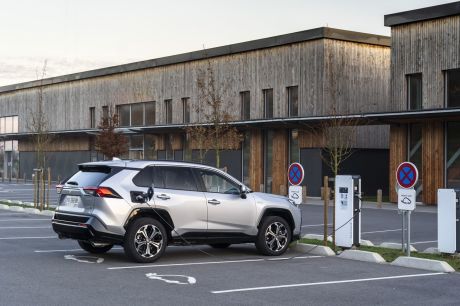
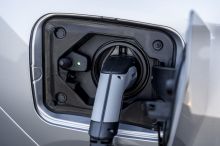
But each medal has its flip side. A full charge on a domestic socket exceeds 10 hours here and should not go under 6.30 a.m. on a Wallbox or public terminal because the on-board charger peaks at only 3.3 kW. Too bad: if it had tolerated direct current recharging (such as the Mitsubishi Eclipse Cross or Mercedes-Benz GLA, capable of recovering 80% of the charge in 30 min on a fast terminal), the Across could have prolonged its long journeys. consumption records recorded in daily use.
Driving
With the batteries full, the Suzuki Across always starts in 100% electric mode. The driving smoothness then culminates, without transforming this vast SUV into the perfect city dweller because its XL size (4.64 m long, like a Peugeot 5008 with seven seats), its large turning diameter, its sensitive parking beeps and its pedal brake a little spongy require a little time to adapt. The silence and zero consumption, however, delight. And then, in this “zero emission” mode, the Across is hardly confined to the city walls.
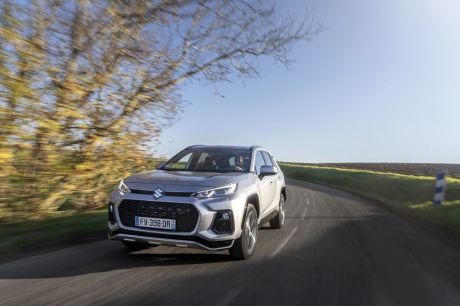
The good power of its electric motors guarantees very correct performance in the flow of traffic and drives the Across up to 130 km / h without ever waking up the 2.5 l thermal. This comes to lend a hand when the accelerator pedal is crushed or the “Hybrid” driving mode is selected. The raises then become impactful… and a little noisy. The epicyclic gearbox causes the engine to stagnate at high stabilized speed but, given the efficiency of the pickups, there is no need to keep it there for very long.
Afterwards, despite 306 hp accumulated and the performances announced (only 6 seconds from 0 to 100 km / h, better than the last Golf GTI!), The Across is not a dynamic SUV and will not be able to keep up with the pace. ‘a Peugeot 3008 HYbrid4, especially on wet roads. In rainy weather, the large Yokohama tires have difficulty gripping the asphalt in roundabouts and allow the front wheels to race under strong acceleration despite the four-wheel drive. Yes: without a drive shaft between the two axles (an electric motor independently powers the rear wheels), the Across E-Four system is not as efficient as a real 4 x 4 transmission. And it has to resort to traction control during express departures at toll gates.
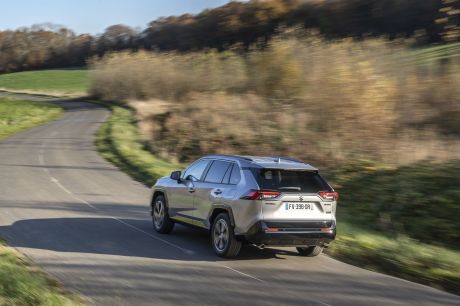
Fortunately, the Across meets all the criteria expected of a family SUV. It is both comfortable on bumps, despite very slight jitters due to the 19 ” wheels, and quiet at steady speed, despite subtle rolling noises that are also certainly attributable to the generous tire mounting. On long journeys, the Across extends this politeness by monitoring its unleaded consumption, increased to 8.1 l / 100 km on hilly motorway at 130 km / h. This is barely more than announced by its less powerful and less heavy rivals (7.8 l for the Peugeot 3008 and Ford Kuga 225 hp), but well below the values displayed by the bad students of the segment: 9, 5 l for the Volkswagen Tiguan eHybrid, or even 12.5 l for the Chinese MG EHS.
This appetite drops again on other courses, especially in town where the “unloaded” Across operates as a non-rechargeable hybrid model. The energy recovery during braking and deceleration (light and not adjustable) makes it possible to restart electrically up to about 20 km / h with a light foot and to stabilize consumption at barely 6 l / 100 km. Reasonable, even if, as with any plug-in hybrid model, it would be a shame not to recharge the batteries every night to reduce consumption to close to zero. With its 66 km of electric autonomy in real conditions, the Across is also one of the rare SUVs to be able to leave its thermal engine dormant all week!
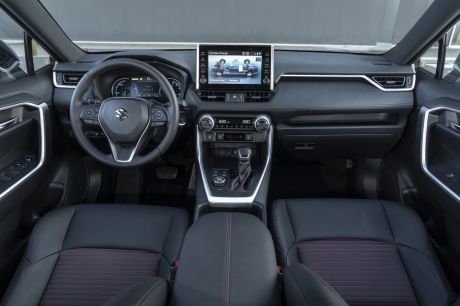
On board

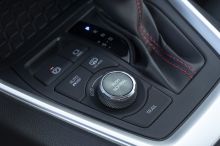
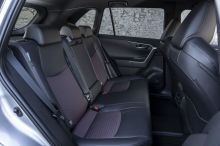
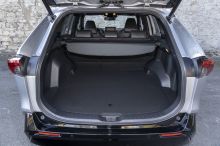
Competition
All detailed in our buying guide, plug-in hybrid SUVs generally combine 225 hp and two-wheel drive. The rivals of the Across, with 300 hp and 4 x 4 transmission, are rarer and boil down to the following models: the Peugeot 3008 and Opel Crossland X HYbrid4 cousins (invoiced respectively from € 50,600 and € 52,250), more dynamic but less livable, and the DS 7 Crossback E-Tense 4 x 4, larger and more comfortable, but also more expensive (56,300 € minimum).
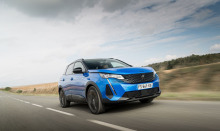

The comparison with its Toyota RAV4 clone remains the most relevant and turns to the (slight) advantage of the Across. Rather than a unique finish like at Suzuki, the RAV4 prefers a range with two equipment levels: Design at € 52,650 (with 18 ”rims instead of 19”, 8 ”screen instead of 9” and monitoring less blind spot) and Collection at € 61,500 (with GPS, 360 ° cameras, head-up display, leather upholstery and ventilated front seats in addition). A discount of € 3,000 is however granted without conditions, allowing the RAV4 Design to recover the € 2,000 bonus and point to € 47,650. Or just € 340 less than the Across, also discounted and “bonus”, but with a slightly higher endowment. It remains to be decided quickly: discounts and bonuses do not last forever …
Find the test report, the equipment and the technical sheet on the next page.
.


