


What are collectables?
These are cars of particular interest, therefore deserving of preservation. Not necessarily old, they nevertheless exist in defined quantities, either because the manufacturer has decided so, or because their production is stopped. Then, they take advantage of features that make them especially desirable: an engine, a chassis, a design, or a concept. Finally, they are likely to see their rating increase. An additional argument to collect them before everyone else!
Why is the Peugeot 205 Rallye collectible?
Rarer than the GTI, the Rallye is not so much less efficient and provides more sensations. Equipped with an ultra-responsive engine and an extremely efficient chassis, it delights sports driving enthusiasts, while it is one of the last Europeans to be powered by two twin-barrel carburettors, a guarantee of responsiveness and beautiful sound.
Saving PSA from bankruptcy is the feat achieved by the 205, launched with it in 1983. Peugeot has developed a sports program to give credibility to its image, which gives the terrible T16 in the race, almost invincible in rally Group B, and in series the GTI, quickly settling at the top of the category of small bombs.
 In 1984, the 205 GTI became the queen of small sports cars, but it cost significantly more than the other models in the range.
First available in 1.6 l of 105 hp then 115 hp, the GTI moved upmarket once fitted with the 1.9 l 130 hp block in 1986, while the “small” models peaked at 80 hp, or even 85 hp after the restyling of 1987 which brings the TU engines. This leaves a gaping space in the offer, which comes to fill, whereas it is not its objective, the spartan Rallye in 1988. This one is intended rather for the amateur pilots, engaging in Group N. it planned, for it to be approved there, to produce only 5,000 units.
 In 1988, the Rallye, intended to run in Group N, recovered some elements inspired by the GTI, such as the front bumper (without the fog lamps) and the wing extensions, on the outside.
However, the car, designed in the same spirit as the AX Sport, has qualities that will appeal to many enthusiasts. Already, instead of being satisfied with the cast iron arms of the XT/XS, it recovers the excellent triangulated front axle which does a lot for the efficiency of the GTI. Then, under its hood, it accommodates the very lively 1.3 l TU engine of the Citroën, pushing it to 103 hp thanks to the installation of two larger double-barrel carburettors, Weber 40 DCOM 10. This is less than the 115 hp of the GTI 1.6 l but here we are, at 780 kg, the Rallye weighs 70 kg less. So that, well helped by the adoption of the very short box of the XS, its accelerations are close, while its price remains much lower: 69,800 F (current €18,000, taking inflation into account) or 15,000 F less.
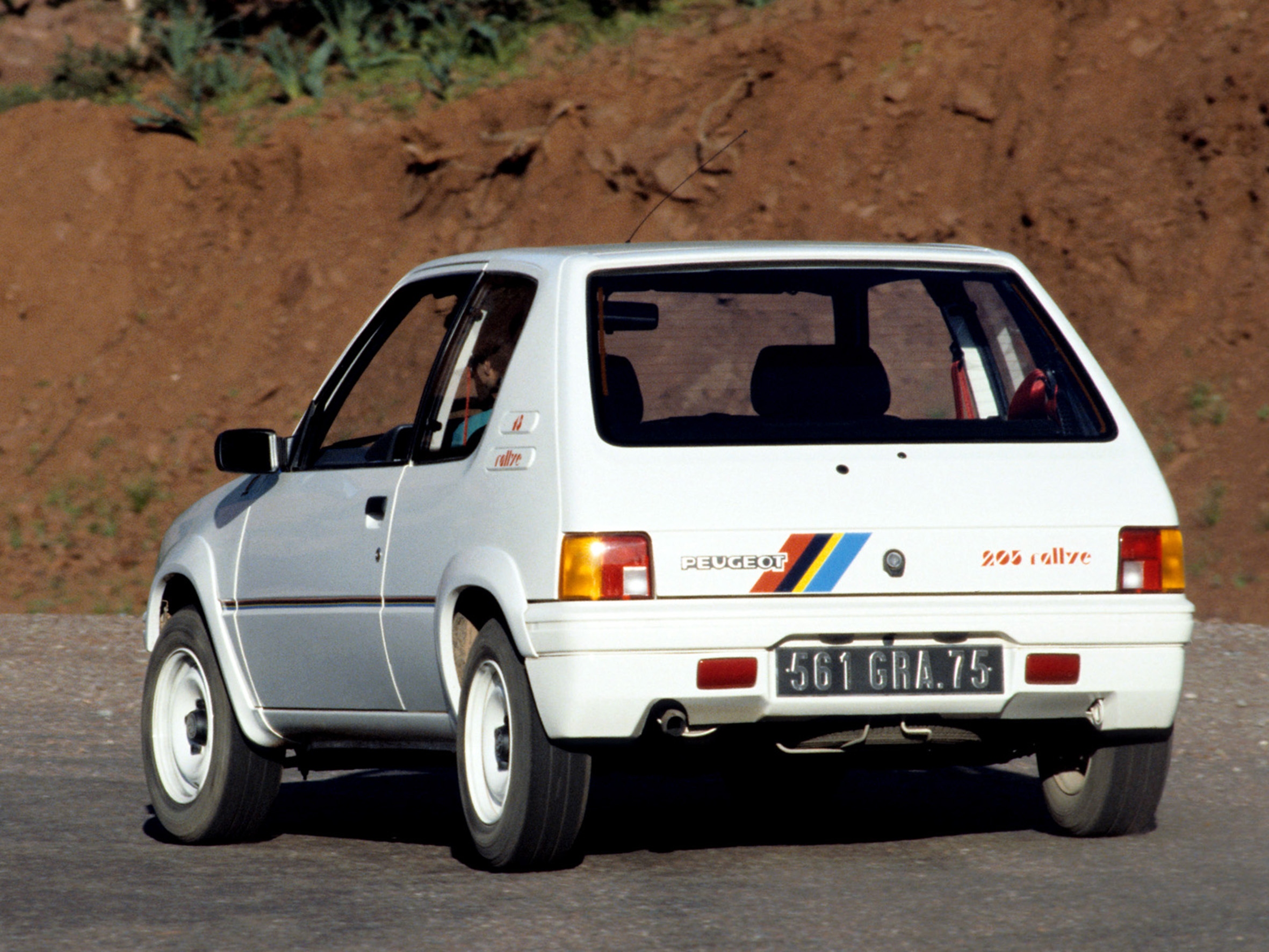 On the Rallye, the rims are those of the current 205 1.4 l, simply painted white. They fit in 165/70 by 13, as on the latter: not really sporty. The standard equipment, minimalist, does not even include a rear windshield wiper.
As a result, and despite barely better equipment than the Junior, the inexpensive model aimed at young people, the Rallye takes the lion’s share of sales, greatly exceeding the initial target, even if it is content to skinny 13-inch rims and rear drum brakes.
Very effective, it is respected by specialists, but will then only evolve very little. In 1990, like the rest of the range, it received white front indicators, and at the rear, lights imitating those of the 405. It disappeared in 1992, for lack of being able to adapt to the new anti-pollution standards, a task will take on another small sports car which will take up the torch: the 106 Rallye. Some 30,000 units were manufactured, which is 6 times more than the original forecast. Nice success!
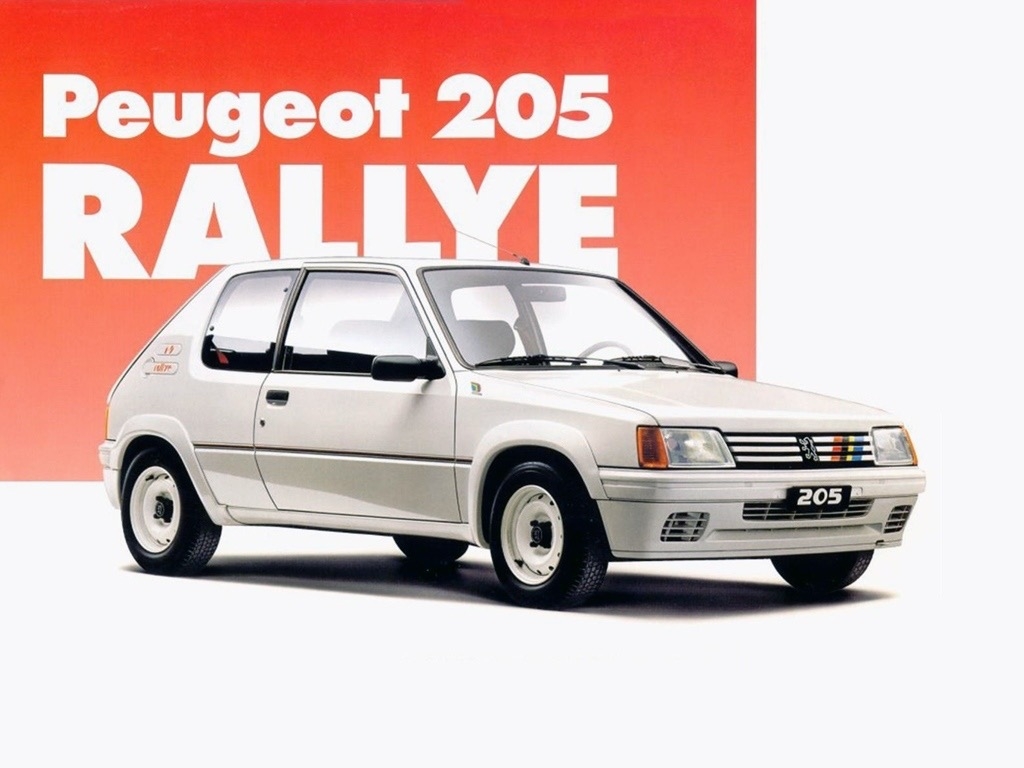 A Rally like the others? No, it’s a version sold in Germany and Switzerland, with a 105 hp injection engine and 1.9 l displacement, as indicated on the rear pillar.
How much does it cost ?
In the shadow of the GTI, the Rallye took longer to see its rating rise, but it is now reaching an estimable level, although much more affordable. There are healthy and functional models that can be improved from €8,000. They exceed 150,000 km, which is not necessarily a handicap. A very fine restored example fetches €15,000, while a car in excellent original condition with less than 100,000 km already claims €17,000.
 Isn’t this Rallye a little weird? It is the one sold in Great Britain from 1994, equipped with a 1.4 l of 75 hp and a raised suspension…
Which version to choose?
Easy, there is only one, at least in France. Prefer cars that are fundamentally sound at the level of the hull, and complete because some original parts have become very difficult to find.
Les versions collector
First of all, there are those in strict factory condition and immaculate, the condition being more important than the mileage. Then, the reconditioned copies.
 Very robust, the Rallye’s TU engine only requires simple maintenance. Only its carburetors are sometimes capricious, especially on hot starts.
What to monitor?
Even driven sportily, the 205 Rallye are mechanically very robust. The small TU engine indeed passes the 200,000 km without major trouble, just like its box. On the other hand, the carburettors know their little glitches and prove to be difficult to adjust: fortunately, the operation is not to be repeated as often as one imagines.
We will also monitor the condition of the hull which, lacking in rigidity, tends to open: inspect the tops of the rear quarter panel, just after the door frame, as well as the feet of the central pillars. Also locate the traces of repair, the Rallye having often gone to the heap. Then, rust can attack, at the junction between the wheel arch and the firewall, or on the floors.
The rear axle suffers from the disease typical of PSA productions of the time: its joints seize up, which generates a pronounced negative camber.
Finally, the seat coverings appear very fragile. No problems with electric windows or central locking: this equipment is conspicuous by its absence!
Driving
 When it comes to performance, the Rallye doesn’t give much back to the 1.6-litre GTI.
We would quickly take the Rallye for a sports Junior. If the equipment is almost as limited as on the latter, distinguishing itself by a more complete instrumentation and seats inspired by those of the GTI, we realize from the first laps that the Rallye is an authentic machine to feelings. Not so capricious at low revs, the engine surprises with its liveliness. It takes 7000 rpm like nothing in a most alluring angry song! And it provides performance that is still very current. The short gearbox ideally supports it in its revving, thanks to its judicious staging and its very rapid control.
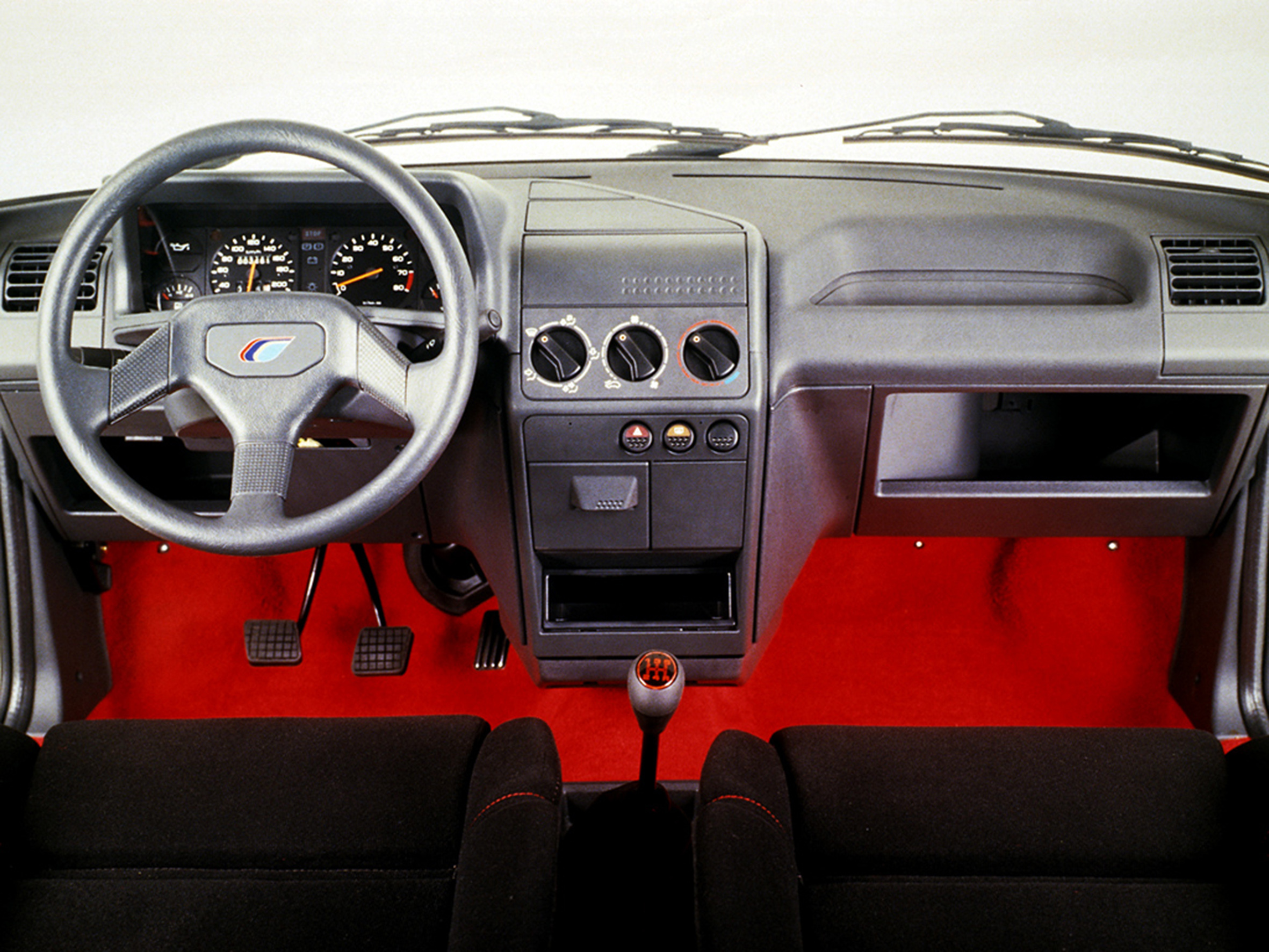 No glove box lid or central air vents, but an instrument cluster (cap and dials) from XS. Even the watch is conspicuous by its absence!
On the chassis side, we are impressed by the precision of the steering, firm in maneuvers but very pleasant afterwards, and the rigor of the running gear. No loss of motor skills, very few body movements, in short, a striking impression of driving a kart with clear feedback! Guided as if by rails, the Rallye nevertheless requires attention to the limit because its stern knows how to be playful. Only the brakes lack a bit of endurance given the speed of the car. In any case, what driving pleasure!
As for comfort, there is nothing unbearable about it, even if the noise level is very high and the driving position is a bit high. Finally, consumption remains reasonable, at 8 l / 100 km when you do not commit excess.
L’alternative youngtimer
Peugeot 104 ZS2 (1979)
 In 1979, the 104 ZS already had 93 hp. Only 1,000 will be produced.
First a peaceful city car when it was launched in 1972, the 104 was available as a coupé from 1973 and went downhill in 1975 when the ZS appeared, with 66 hp. But 4 years later, it took a step further when the ZS2 limited series was unveiled, produced in 1,000 units at the start of 1979. Under its hood, it housed a 1,360 cm3 which, fed by two twin-barrel carburettors, developed some 93 hp . With this beating heart, the little lioness flirts with 180 km/h and goes from 0 to 100 km/h in 10.5 seconds. Externally, it is distinguished by its Amil aluminum rims as well as its red side stripe.
In the passenger compartment, it retains the dashboard of the base model, but adds a tachometer as an accessory. In addition, we are entitled to a more substantial board. As a test drive, the ZS2 seduces with its performance and agility, even if its suspension is flexible. Today very difficult to find, this early GTI is extremely expensive: more than €30,000!
Peugeot 205 Rallye (1988), the technical sheet
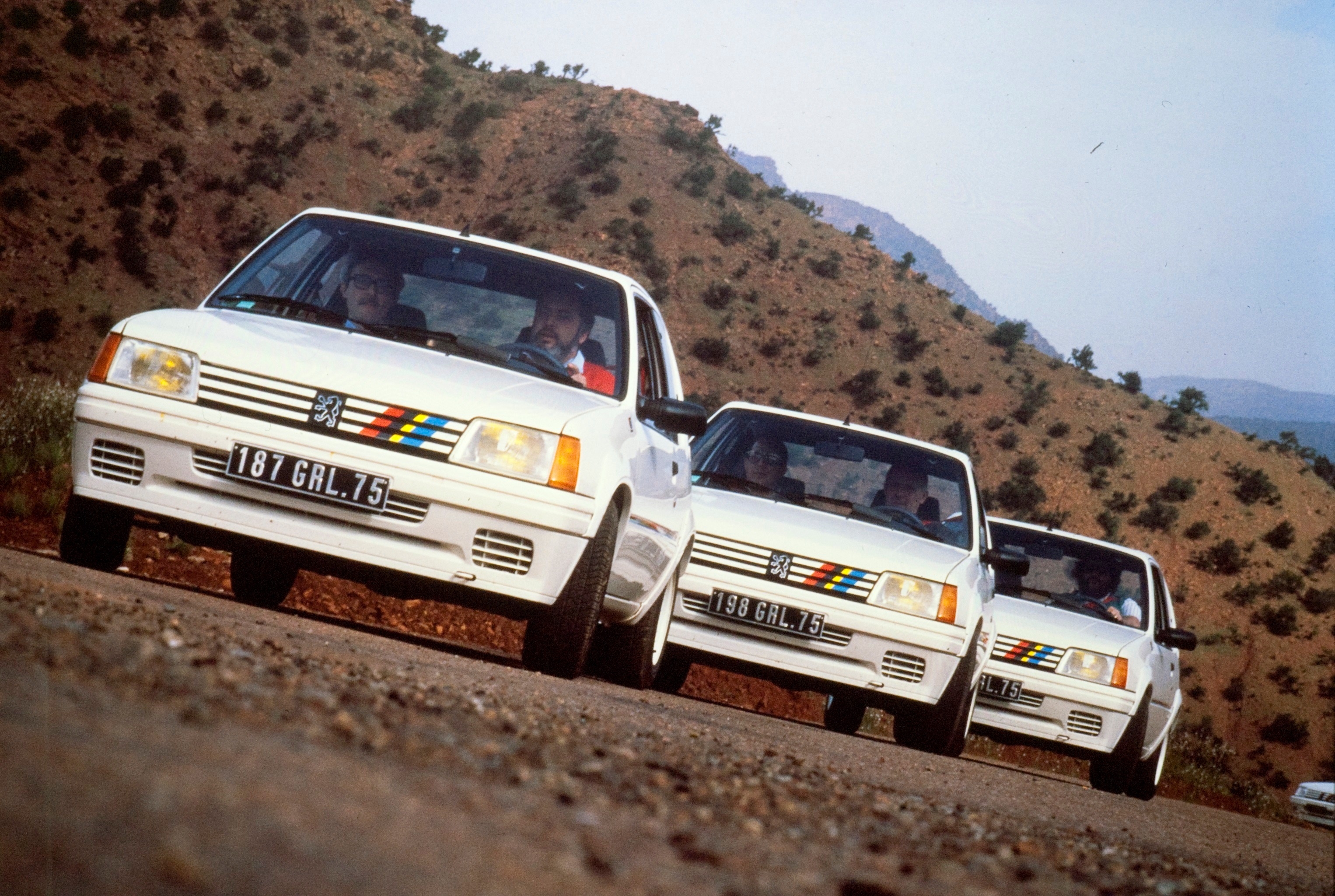 205 Rallye tested in 1988. Note the absence of a right rear-view mirror, as on the vast majority of Peugeots of the time… Engine: 4-cylinder in line, 1,294 cm3 Fuel supply: two twin-barrel carburettors Suspension: McPherson struts, coil springs, anti-roll bar (front) low pull, torsion bars, anti-roll bar (rear) Transmission: 5 manual gearbox, traction Power: 103 hp at 6,800 rpm Torque: 120 Nm at 5,000 rpm Weight: 780 kg Maximum speed: 190 km/h (manufacturer data) 0 to 100 km/h: 9.6 s (manufacturer data)
> To find advertisements for Peugeot 205, go to the website of The Central.


